Unhealthy Food: The Science Behind Its Deliciousness
Unhealthy Food: The Science Behind Its Deliciousness
Unhealthy food often tastes better because it hits the brain and body in fast, powerful ways. It combines sugar, fat, salt, texture, and smell in a format that the brain reads as highly rewarding. Healthy foods can taste great too, but they usually do not trigger the same sharp pleasure response, especially at first.
The short answer is this: junk food is built to feel more rewarding than plain, whole foods. It gives quick energy, strong sensory feedback, and repeated pleasure signals that shape both Nutritional Behavior and habit.
Why junk food feels so rewarding
The main reason is a split between liking and wanting.
- Liking is the actual pleasure you feel while eating.
- Wanting is the drive to seek the food again.
With hyperpalatable foods, these two can separate. A person may enjoy the taste a little less over time, but still crave it more. Research shows that repeated exposure to very tasty, high-fat or high-sugar foods can cause habituation to the taste, while the urge to eat them grows stronger. Some studies also show a blunted reward response to the same food after frequent intake, similar to tolerance.
Biological reasons junk food tastes “better”
1) Dopamine and reward signaling
Junk food strongly activates the brain’s reward system, especially in areas like the nucleus accumbens, striatum, and ventral tegmental area (VTA). These areas help the brain learn what feels rewarding.
When you eat sugar and fat together, the brain often releases more dopamine than it does for many less processed foods. Dopamine does not just create pleasure. It also teaches the brain to repeat the behavior. That is why a food can become more desired after repeated exposure, even if it is not truly more enjoyable every time.
2) Opioid and endocannabinoid pathways
The brain also uses opioid and endocannabinoid systems to boost the pleasure of eating. These systems help explain why rich, creamy, sweet, and salty foods feel so satisfying. They intensify the “peak” of pleasure during eating, which makes the food feel more rewarding than simpler foods.
3) Satiety signals can be overrun
Healthy eating usually depends more on the body’s natural fullness signals. Junk food can interfere with that process.
- High sugar can cause fast blood sugar swings.
- High fat can slow digestion and make it easier to keep eating.
- Strong flavor and texture can make food feel less filling than it is.
Some research also shows that long-term high-fat diets may reduce normal reward sensitivity and alter signals that help control eating. This can make people less interested in plain foods and more drawn to intense flavors.
4) Gut-brain effects
Food does not affect the brain only through taste. It also affects hormones and gut signals. Meals high in sugar and fat can shift hormones linked to hunger and fullness, such as insulin, leptin, and ghrelin. Over time, this can change appetite and food preference. Understanding these connections is a core part of Nutritional Psychiatry: Your Brain on Food, which explores how our dietary choices impact our mental well-being.
The gut microbiome may also play a role. Diets high in ultra-processed foods can change gut bacteria patterns, which may affect cravings, metabolism, and even mood. The research is still developing, but the gut-brain link helps explain why eating patterns can become hard to break.
Why the brain learns to prefer junk food
A big reason unhealthy food seems to taste better is learning.
Conditioning and association
The brain starts to connect junk food with:
- TV, movies, and gaming
- parties and celebrations
- stress relief
- driving, work breaks, or late-night snacking
- brand logos, colors, and packaging
After enough repetition, the sight or smell of the food can trigger craving before the first bite. This is called classical conditioning. The food cue becomes a reward cue.
Habit formation
Over time, eating junk food can become automatic. You may not feel truly hungry, but the habit still triggers the urge to eat. This is operant conditioning in action: the brain remembers that the food gave comfort, pleasure, or relief before, so it pushes you to repeat the behavior.
Emotional learning
People often link junk food with comfort or reward. A person who eats ice cream after a stressful day may start to feel that ice cream “tastes better” because it is tied to relief and safety, not just flavor. Healthy foods usually do not get paired with the same strong emotional reward. Organizations like the FDA conduct Social and Behavioral Science Research for Food to better understand these consumer choices and their health implications.
Why evolution shaped these cravings
Humans did not evolve in a food-rich setting. For most of history, calories were scarce. The brain learned to prefer foods that helped survival.
Sugar
Sweet foods often meant ripe fruit, honey, or other fast energy sources. Sugar gave the brain quick fuel, so liking sweetness had clear survival value.
Fat
Fat contains about twice the energy per gram as protein or carbohydrates. In times of hunger, fat was a valuable energy reserve. A strong drive for fatty foods helped humans survive periods of scarcity.
Salt
Salt was once hard to get, but it was essential for nerve function, muscle activity, and fluid balance. A preference for salty foods had a survival benefit.
Why that matters now
Today, these survival-driven preferences are pushed hard by food products that combine sugar, fat, and salt in very high amounts. In a setting where these foods are easy to get and cheap to buy, the same brain systems that once helped survival can now drive overeating.
Sensory science: why junk food feels more satisfying
Taste is only part of the story. Texture, smell, and sound matter a lot.
| Sensory feature | Why it matters | Why junk food often wins |
|---|---|---|
| Crunchiness | Gives instant feedback and signals freshness | Chips, crackers, and fried foods create a strong crunch that feels satisfying |
| Creamy mouthfeel | Makes food feel rich and smooth | Fat coats the mouth and carries flavor well |
| Aroma | Smell shapes taste before and during eating | Processing and frying create strong aroma compounds |
| Textural contrast | Different textures in one bite feel more exciting | Crispy outside with soft inside raises satisfaction |
| Sound | The sound of a bite affects perception | A “clean break” or crisp snap can make food seem fresher and tastier |
The role of the Maillard reaction
High-heat cooking creates the Maillard reaction, which forms aroma compounds such as pyrazines and furans. These are linked with roasted, fried, and caramelized notes. Humans tend to like these smells because they signal dense, cooked food with high energy content.
Fat as a flavor carrier
Fat helps flavor linger and spread across the mouth. It also creates a smooth, rich feeling that many people find indulgent. This makes foods like pizza, chips, fries, pastries, and ice cream harder to resist than many plain healthy foods.
Exact brain findings from research
Several studies directly compare how the brain responds to high-reward foods versus less palatable foods.
| Study type | Main finding |
|---|---|
| fMRI studies of palatable food cues | High-sugar and high-fat foods often produce stronger activation in reward-related brain areas than plain foods |
| Repeated exposure studies | Frequent intake of the same highly palatable food can reduce the brain’s response to that food, while craving remains high |
| Brain reward sensitivity studies | Long-term junk food intake can weaken response in reward circuits, including the VTA, and reduce interest in other natural rewards |
| Cue-reactivity experiments | Food cues linked to junk food can trigger stronger craving and attention than cues linked to plain foods |
What these studies mean
The brain does not always respond to food based on nutrition. It often responds based on:
- expected reward
- learned cues
- past pleasure
- fast sensory impact
So a healthy food may be better for the body, but a junk food item may still trigger a stronger immediate reward response in the brain.
Why healthy food can taste less exciting at first
Healthy foods often lose in the first comparison because they are usually:
- lower in sugar, salt, and fat
- less crunchy or creamy
- less aromatic after processing
- less engineered for instant reward
- not tied to strong emotional habits
That does not mean healthy food tastes bad. It often means the palate needs time to adjust. Once someone reduces ultra-processed foods, many whole foods start to taste better because the brain is no longer expecting such intense sweetness, salt, or fat.
Bottom line
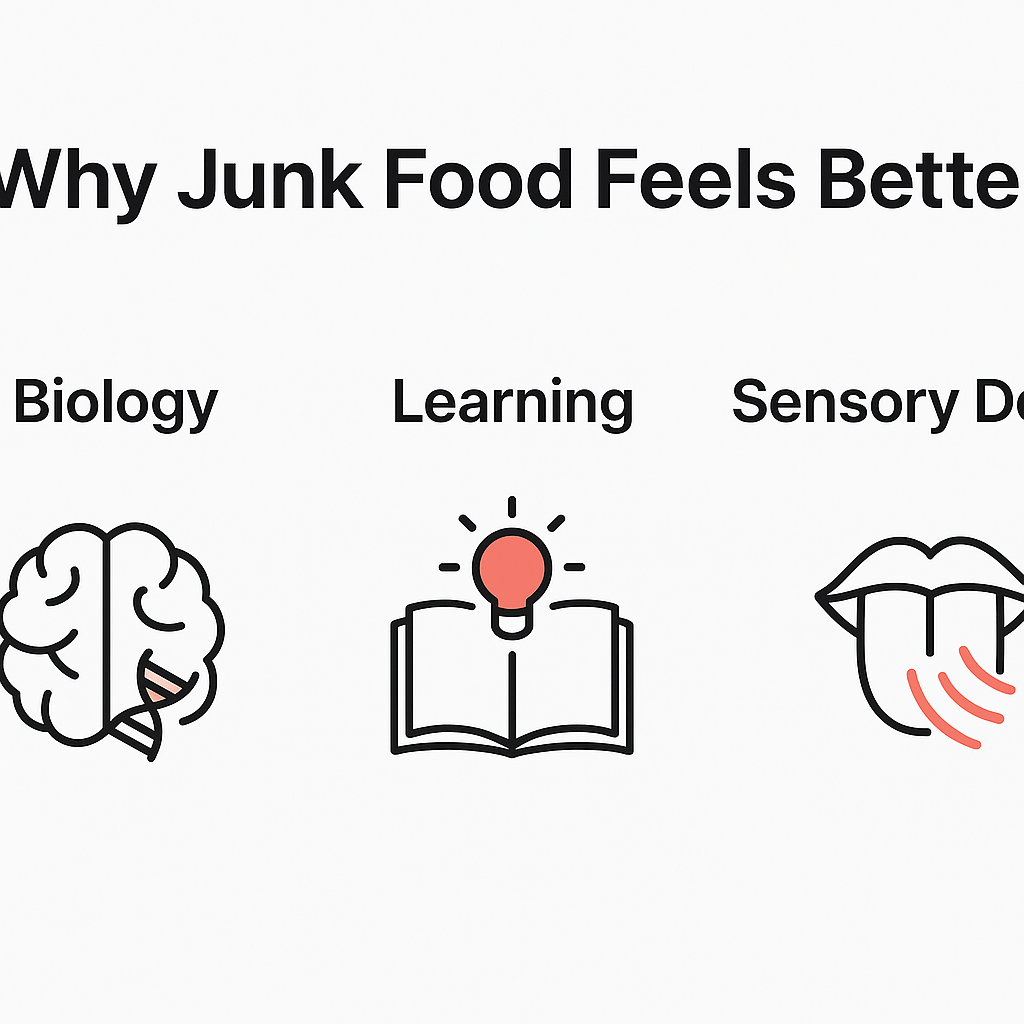
Unhealthy food often tastes better because it combines biology, learning, and sensory design.
- It activates reward circuits strongly.
- It uses sugar, fat, and salt that humans evolved to seek.
- It trains the brain through habit and cue learning.
- It delivers strong smell, crunch, creaminess, and flavor release.
- It can increase wanting even when liking fades.
That is why junk food can feel more delicious than healthy food, even when it offers less nutrition.